

Too busy to read today? Listen to The Capitalist Voice anywhere. Just click the image.
“Two households, both alike in dignity, In fair Emilia-Romagna, where we lay our scene, From ancient grudge break to new mutiny, Where supercars makes civil driving licenses unclean.”
In the summer of 1963, two men stood on opposite sides of a garage in Maranello and changed the future of speed forever. Enzo Ferrari, the austere, black-clad patriarch who had already turned his name into a synonym for victory, listened as Ferruccio Lamborghini—wealthy tractor magnate and frustrated Ferrari owner—complained that the broken clutch in his Ferrari was the same one he used in his tractors and suggested improvements.
Enzo, never one to suffer criticism lightly, reportedly replied that if Lamborghini thought he could build a better car, he should try, or words to that effect. Ferruccio did exactly that. Within months he founded Automobili Lamborghini, and the most famous rivalry in automotive history was born.
For more than six decades the prancing horse and the raging bull have defined the outer limits of what a road car can be. Their flagship machines read like a roll of automotive honor—Ferrari’s 250 GTO, F40, Enzo, and LaFerrari; Lamborghini’s Miura, Countach, Diablo, and Aventador—have not merely competed; they have staged a rolling opera of one-upmanship that shaped the very idea of the modern supercar. The 1966 Miura’s revolutionary transverse mid-engine layout gave birth to the modern super car and forced Ferrari to respond with the Daytona. The Countach’s scissor doors and angular aggression made the Ferrari 512 BB look almost pedestrian.
“To get some idea of what it must have been like to own a Lamborghini Countach in 1971, imagine parking stealth bomber on your lawn today” -Jeremy Clarkson - The Rise and Fall of the Supercar
When Ferrari unveiled the F40 in 1987 as the last car personally approved by Enzo, Lamborghini answered with the wild, 200-mph Diablo. The duel was never just about numbers. It was about mythology. A blood feud that was fought on the twisting hills of Northern Italy.
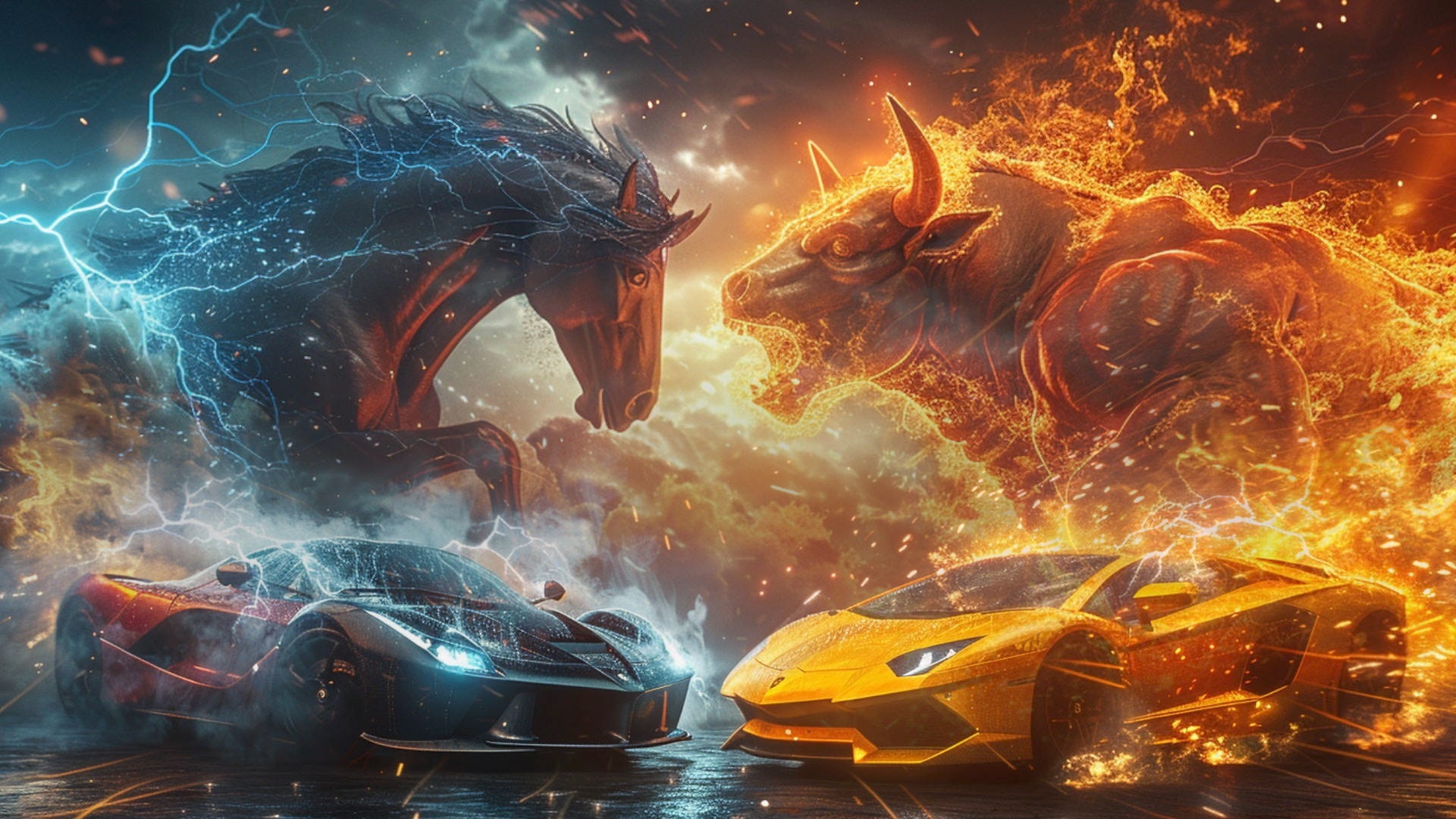
At the heart of that mythology lay an unspoken philosophical divide. One camp—let us call them the Progressives—believes the worth of a car is measured in lap times, aerodynamic efficiency, and raw technological supremacy. The other camp—the Purists—insists that a car without the visceral theater of sound, smell, and mechanical drama is no longer a car at all; it is a very fast appliance with all the sex appeal of a dishwasher. For decades both Ferrari and Lamborghini managed to serve both tribes. Ferrari gave the world icons like the 355 and the screaming V12 of the 812 Superfast and the hybrid LaFerrari. Lamborghini answered with the thunderous V12 Aventador and the outrageous Urus, which proved even an SUV could still feel like a bull in a china shop.
That delicate balance is now under existential strain. Lamborghini has walked away from a pure-electric future, its leadership citing “almost zero demand” in the luxury supercar segment and with true Italian flair declared its foray in to EV’s “an expensive hobby.“ Ferrari, by contrast, is pressing ahead. Its first battery-electric vehicle, codenamed Luce, is expected to open for orders this spring. The company however has halved its 2030 EV sales target from 40 percent to 20 percent, a quiet acknowledgment perhaps that the market is not as “electrifying” as once hoped. Yet even that reduced ambition represents a historic pivot for the house of the prancing horse, but the data from the broader luxury segment is sobering.
The Capitalist is a reader-supported publication
Reject Corporate Left Wing Journalism
High-end electric vehicles with stellar nameplates have largely bombed. Rolls-Royce’s Spectre, the first fully electric Rolls in history, has sold modestly. Bentley’s Flying Spur Hybrid and Continental GT Speed Hybrid have far outsold their pure-EV siblings. Aston Martin’s Lagonda project was quietly shelved. Even Porsche, the most successful electrifier among traditional sports-car makers, has seen its Taycan sales plateau while the gasoline 911 remains the undisputed profit king. The emotional connection that Lamborghini’s leadership openly mourns—the howl of a V12 at 9,000 rpm, the theatrical bark on overrun, the smell of racing fuel and hot carbon—has proven much more elusive to replicate than EV evangelists predicted no matter how storied the name.
Ferrari is attempting to thread that almost impossible of needles. It must satisfy the Progressives who demand that Maranello remain at the cutting edge of technology while reassuring the Purists that the soul of the brand will survive. The company’s strategy has always been to evolve without ever fully abandoning its past; the hybrid SF90 and 296 GTB showed it could blend electric torque with screaming V6 and V8 drama. But a pure EV is different. There is no engine note to synthesize, no mechanical heartbeat to preserve (and no, piping in a digital soundtrack of a wailing V8 through the stereo system is not a solution.) The risk is that in chasing the future, Ferrari alienates the very customers who have sustained the myth for ninety years.
The old rivalry, once so fertile, now feels like a referendum on two competing visions of automotive destiny. Lamborghini has chosen to double down on what it does best: theater, emotion, and unapologetic excess. Ferrari has chosen to bet that even the most devout Purists will eventually accept electrification if the car is fast enough, beautiful enough, and still (somehow?) “feels” like a Ferrari even if it has no soundtrack.
History suggests the bet is far from certain. When the Miura arrived in 1966, many traditionalists dismissed it as a toy. When the F40 appeared, some called it crude. Today we know how wrong the critics were, both cars are now revered as masterpieces that transcend time. The question is whether the electric Luce will one day be spoken of in the same breath—or whether it will be remembered as the moment the prancing horse took a turn to the glue factory?
The garage in Maranello is quiet these days. Enzo and Ferruccio are long gone. But their argument continues, now carried on not in angry words but in spreadsheets, regulatory deadlines, and the quiet hopes of engineers and enthusiasts alike. One camp still believes that progress must never come at the expense of soul. The other insists that refusing to evolve is the surest way to lose both.
Editor’s Note: Before you click away dear reader, we would ask you to watch what is probably one of the most moving things ever committed to film.
A glorified dishwasher just doesn’t make you feel like this does.
Ferrari has a steep hill to climb.

