


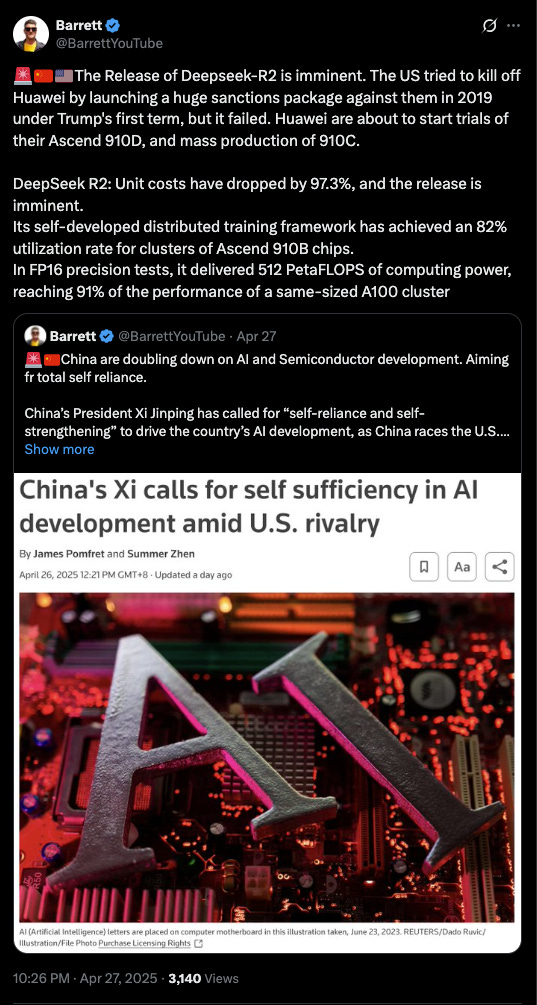
What's New: Huawei is set to test its Ascend 910D AI chip next month, aiming to rival Nvidia’s H100 and fill the gap left by U.S. export bans.
Why It Matters: With Nvidia’s advanced chips restricted in China, Huawei’s push signals Beijing’s drive for semiconductor self-sufficiency, escalating the U.S.-China tech race.
Key Details: The Ascend 910D, touted to outperform Nvidia’s H100, will undergo testing by Chinese tech giants like ByteDance and Baidu starting late May. Huawei has already shipped over 800,000 Ascend 910B and 910C chips this year, capitalizing on U.S. curbs that cost Nvidia a $5.5 billion hit. Analysts at SemiAnalysis note Huawei’s chips, while lagging Nvidia’s latest, offset performance gaps with volume—potentially producing 1.3 million units next year. China’s strategy of clustering chips, like Huawei’s CloudMatrix 384, boosts computing power without cutting-edge manufacturing.
The Big Picture: Huawei’s rapid chip development, despite U.S. sanctions, underscores China’s resilience in AI hardware. As tensions rise, this move could reshape global AI infrastructure, creating a bifurcated tech ecosystem. Nvidia’s soaring stock price has previously shown that it is not impervious to outside competitors in the Ai space. The launch of the China-based open source “Deepseek” Ai model caused concern about the US falling behind China in the Ai arms race and lead to a sell off in Nvidia in January.
Market Brief:
After a VERY rocky April, Markets brace for “Magnificent 7” earnings under the shadow of trade talks and economic data reports. Over 180 S&P 500 firms, including Amazon, Apple, Meta, and Microsoft of the “Magnificent 7”, report earnings this week. This adds to an already busy week for investors, with major releases of economic data including Wednesday’s GDP and inflation reports, and Friday’s employment numbers.

U.S.-China trade developments are adding to the tension amid Trump’s big tariff play. Treasury Secretary Scott Bessent, speaking on CNBC, downplayed U.S. responsibility for trade de-escalation, noting China’s disproportionate exports make its tariffs unsustainable. Although progress on a potential India trade deal was highlighted.
April has been highly volatile for the major indexes, with the S&P 500 down over 2%, the Dow nearing a 5% loss, and the Nasdaq down nearly 1% leading to concerns about the tech-heavy Mag 7’s earnings.
All three of the major indexes slipped in morning trading but as the afternoon began there were signs of a rally.
Massive Blackout Plunges Spain, Portugal into Darkness
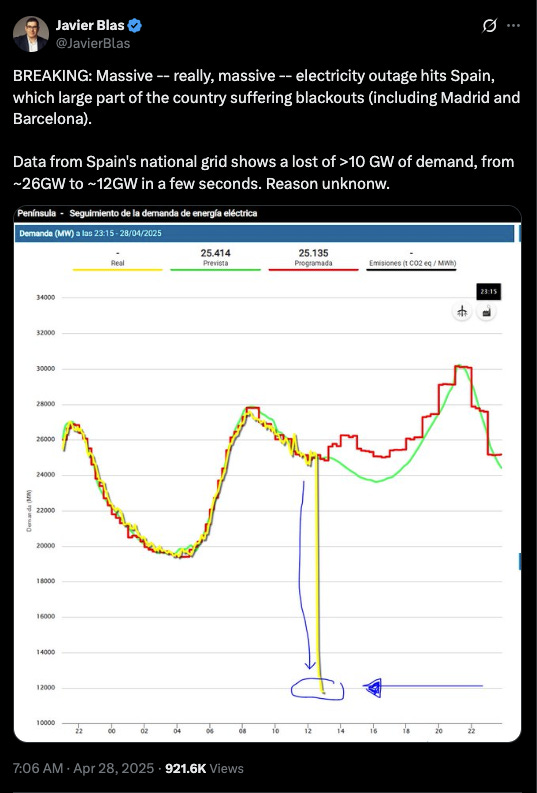
A colossal power outage struck Spain and Portugal on Monday, crippling major cities and disrupting daily life. Spain’s national grid lost over 10 gigawatts of demand in seconds, dropping from 26GW to 12GW, according to Red Electrica, the country’s grid operator.
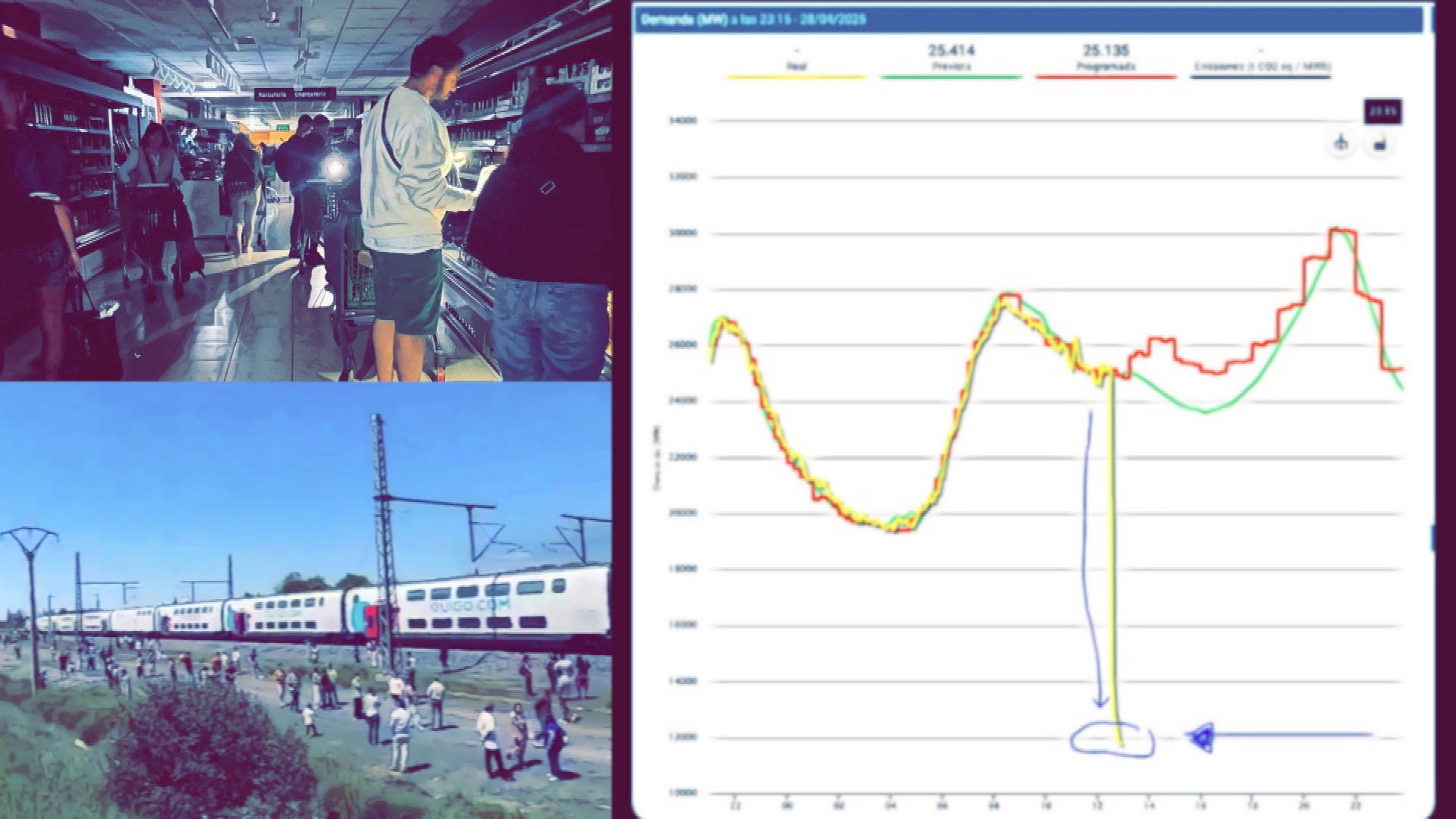
Why it matters: The blackout, described as “massive — really, massive” by Bloomberg’s Javier Blas, halted transportation, grounded flights, and left millions without power. Seville, Barcelona, and Valencia were among the hardest hit, with parts of France also briefly affected, per Spanish media.
What’s happening: Red Electrica activated restoration plans but provided no clear cause, saying only that it’s under investigation. Spanish authorities are working with sector companies to restore electricity, a process that could take hours.
The big picture: The outage underscores vulnerabilities in Europe’s power infrastructure, raising concerns about grid reliability amid increasing energy demands.
What to watch: Investigations into the blackout’s cause could reveal whether it was a technical failure, cyberattack, or environmental factor, shaping future grid investments.

IBM pledges $150 billion to boost U.S. economy, computing dominance

What’s happening: IBM, a tech industry titan, announced a $150 billion investment in the U.S. over the next five years to drive economic growth and cement its global leadership in computing, per a company release.
Why it matters: The move underscores IBM’s focus on American jobs and innovation, reinforcing its role in advanced computing and AI.
"Technology doesn’t just build the future — it defines it," Arvind Krishna, IBM chairman, president and CEO, said in a statement. "We have been focused on American jobs and manufacturing since our founding 114 years ago, and with this investment and manufacturing commitment we are ensuring that IBM remains the epicenter of the world’s most advanced computing and AI capabilities."
IBM makes mainframe high-performance computers in Poughkeepsie, New York, "that are the technology backbone of the American and global economies. More than 70% of the entire world’s transactions by value run through the IBM mainframes that are manufactured right here in America."
Founded in 1911 as the Computing-Tabulating-Recording Company and renamed IBM in 1924, the firm has a legacy of powering major milestones, from the U.S. social security system to the Apollo moon landings. It also plans to keep designing and building quantum computers domestically.
“Technology doesn’t just build the future — it defines it,” Krishna said.
IBM reported $14.5 billion in revenue for Q1 2025 last week.
What’s next: The investment aims to strengthen IBM’s manufacturing and innovation footprint, ensuring it remains a global tech leader.
