
The Capitalist exists because of you, and we want to hear from you!
Become a paid subscriber today to support The Capitalist
and access the Live Capitalist chat
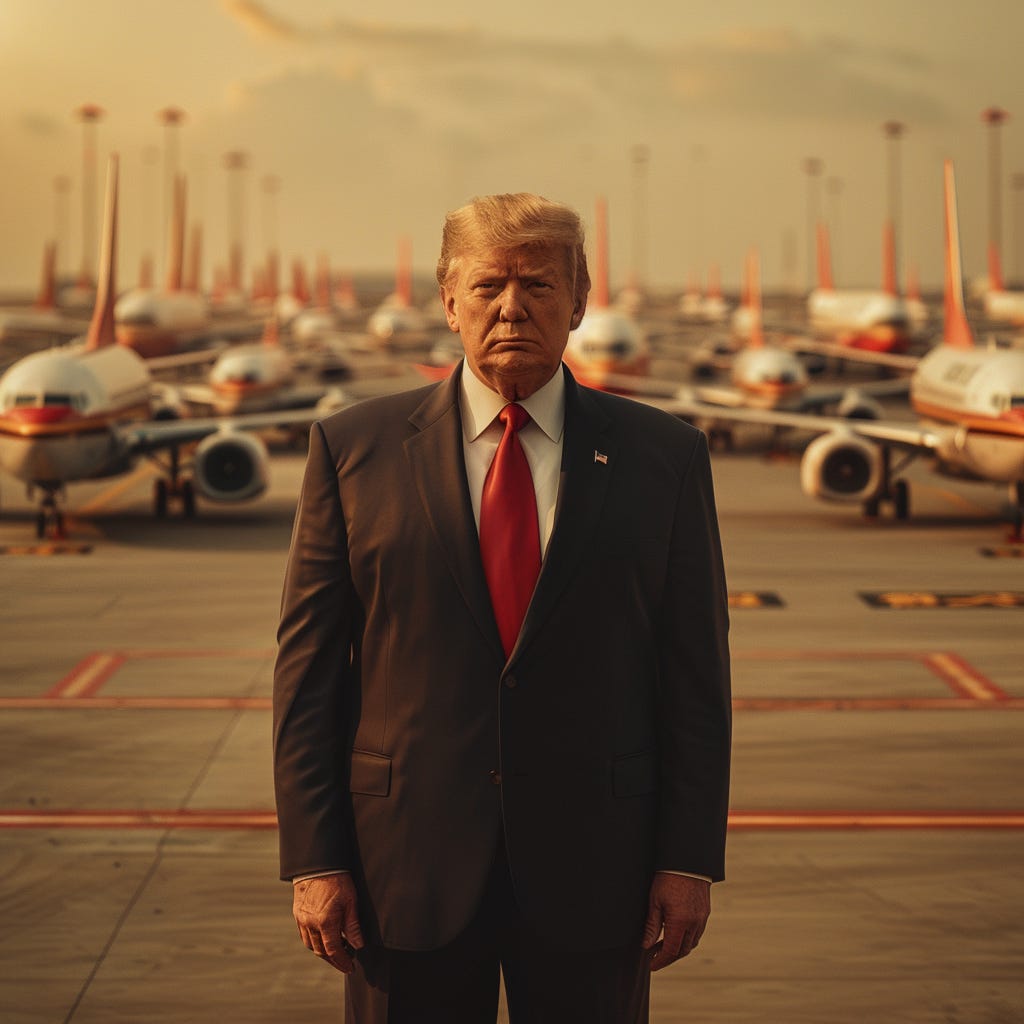
China just agreed to buy 200 Boeing jets. Not a press release full of vague promises. Not some future framework. A straight-up order, announced by President Trump after sitting down with Xi Jinping in Beijing this week. That’s the kind of concrete number that actually moves the needle for American factories, suppliers, and paychecks.
Boeing’s own CEO, Kelly Ortberg, had called the potential “a big number” but tied it explicitly to whatever Trump and Xi could hammer out. Trump pushed and got 200—more than Boeing had initially pitched at 150. These are mostly 737 Max narrowbodies, the workhorse planes Chinese airlines desperately need after years of leaning on Airbus instead. Boeing hadn’t landed a major order from China in nearly a decade.
What makes this more than just another aircraft sale is how it happened. Trump didn’t roll into Beijing with a handful of diplomats and lobbyists. He brought the deepest bench of American corporate firepower assembled in decades: Boeing’s Ortberg, Tesla and SpaceX’s Elon Musk, Apple’s Tim Cook, Nvidia’s Jensen Huang, BlackRock’s Larry Fink, Citigroup’s Jane Fraser, Cargill’s Brian Sikes, and others from Qualcomm, Exxon, Blackstone, Mastercard and Visa. These aren’t symbolic names. They run companies that employ hundreds of thousands, move trillions, and sit at the sharp end of both manufacturing and cutting-edge tech and finance. The message was unmistakable: America’s business leadership was at the table, not watching from the sidelines.
This wasn’t some feel-good photo op. It was deal-making with leverage. Despite all the tariff friction, the threats, the supply-chain arguments, and the endless Washington hand-wringing about “decoupling,” the simple fact remains: China still needs what America builds. Commercial jets that fly reliably and efficiently. Advanced AI chips that power the next generation of computing. Boeing planes fill airline fleets. Nvidia silicon keeps data centers humming. Beijing can talk tough about self-reliance all it wants, but the math on the ground says otherwise. The two biggest economies on the planet still need each other in ways that sanctions and speeches and even spats over tariffs can’t erase.
Sponsored by: Goldco
[RIP the Penny] Inflation’s Wrath Strikes Again

The lowest denomination of our currency is being wiped out by the same force that is silently, steadily, and relentlessly eating away at your hard-earned savings, 401(k), and purchasing power.
You need to understand the mechanics of this major threat—and how you could help protect yourself—now, before the next wave of inflation potentially hits.
Your Defensive Strategy Starts Here ( and it’s FREE)
The Boeing order alone is a direct win for American industry. Boeing’s commercial airplane business has been grinding through production ramps, quality issues, and a post-pandemic recovery that’s been anything but smooth. A fresh 200-plane commitment from China’s state-backed carriers means steady work for factories in Washington state, South Carolina, and the thousands of suppliers scattered across the country. These aren’t abstract “good for GDP” numbers. They translate into welders, engineers, machinists, and logistics workers who get overtime, benefits, and job security. Aviation is one of the few sectors where the U.S. still holds a clear global edge. Keeping those order books full matters more than any tariff tweet ever could.
Xi didn’t stop at the aircraft deal. He told the assembled CEOs, point blank, that China’s door to U.S. business will “open wider.” State media quoted him saying American companies have benefited from China’s reforms and that U.S. firms will enjoy “even broader prospects” going forward. That’s not boilerplate. It came directly to Musk, Cook, Huang, and the rest while Trump sat there. Xi knows the delegation represented real money and real technology. He also knows China’s economy is under pressure—slowing growth, property troubles, demographic headwinds. Opening wider isn’t charity; it’s pragmatism. The CEOs heard it loud and clear.
None of this erases the bigger trade fights. Tariffs are still in place. Tech export controls still exist. Supply-chain security remains a legitimate worry for both sides. But the Beijing summit cut through the noise and showed what actually gets results: high-level, personal deal-making backed by the people who run the companies that matter. Trump has always sold himself as the guy who can sit across from tough negotiators and extract concessions. This week he delivered something measurable. Two hundred planes. A signal of wider market access. And a reminder that, for all the rhetoric, America still holds cards China wants to play.
Become a paid subscriber today and access the Live Capitalist chat
The president’s critics will downplay it. They’ll call it transactional, short-term, or somehow beneath the dignity of grand strategy. Fine. Grand strategy is what you talk about when you’re not closing deals. The workers who build 737s in Everett, Washington, don’t get paid in theories. They get paid when orders land. The suppliers who machine parts for those planes don’t care about ideological purity tests; they care about the next purchase order. This deal puts cash in their pockets and steel in the supply chain.
It also undercuts the narrative that America has nothing left to offer except lectures. China’s airlines need planes now. Its tech sector needs chips it can’t yet replicate at scale. Xi’s “open wider” line was a public acknowledgment that U.S. companies remain essential partners, not just rivals to be squeezed out. That’s leverage worth using. Not forever, not without guardrails, but right now, while the numbers still favor us.
No one should pretend this resets the entire U.S.-China relationship. One aircraft order and some warm words from Xi don’t solve intellectual-property theft, forced technology transfer, or the military tensions in the South China Sea. But dismissing concrete economic wins because they don’t solve every problem is how you end up with no wins at all. Trump showed up with the CEOs who actually run things. He got a deal on jets. He got China talking about broader access. And he reminded everyone that when the world’s two largest economies sit down, the conversation still starts with what each side can buy and sell.
That’s not flashy. It’s not revolutionary. It’s just business—the kind that keeps American factories running and American workers employed. In a town full of people who prefer endless strategic seminars, this week’s results in Beijing were refreshingly straightforward: America had what China needed, Trump brought the team that could deliver it, and the order book moved.
For once, the deal actually happened.
Let us know your thoughts in the new Capitalist chat portal.