


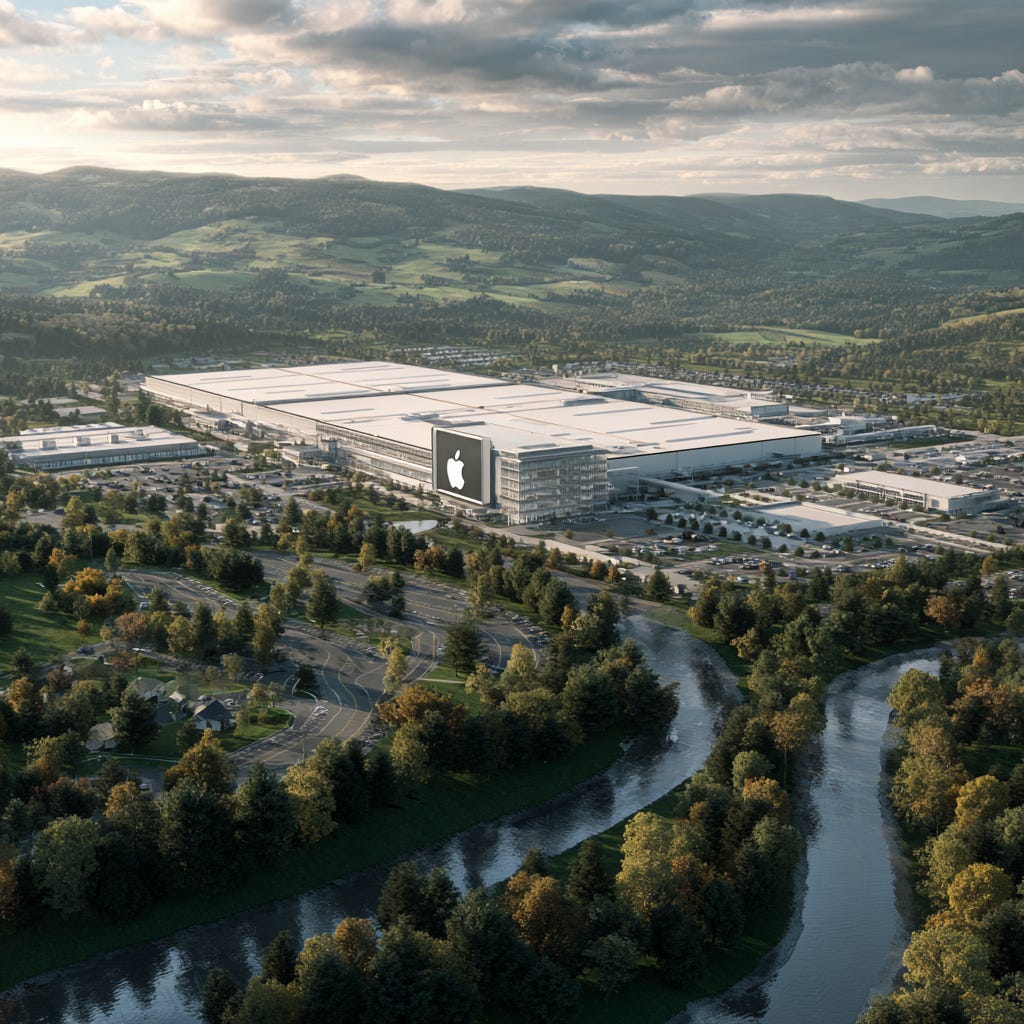
The images from the Oval Office last week told a story that extends far beyond Apple's boardroom. When CEO Tim Cook stood alongside President Trump to announce Apple's historic $600 billion investment in American manufacturing, they weren't just unveiling a new corporate strategy—they were demonstrating a commitment to reverse decades of economic decline and restore opportunity to America's heartland.
Apple's promise to create 20,000 direct jobs and expand manufacturing across 12 states signals a fundamental shift in how America competes in the global economy. After watching helplessly as manufacturing jobs migrated overseas for generations, middle-class families finally have reason for optimism.
President Trump's strategic use of tariffs and domestic investment incentives has created an economic environment that makes reshoring patriotic and profitable. The 100% semiconductor tariff, coupled with exemptions for companies building domestically, represents precisely the kind of innovative policy thinking that Washington has lacked for decades. Critics who dismiss this as protectionism miss the point entirely—this is about creating sustainable competitive fairness in global trade that benefits American workers looking to win on an even playing field.
A message from our sponsor (piece continues below)
The $18,000 House You Missed

Pop quiz:
It’s 1970. You have $18,000 in gold coins.
Option A: Sell the coins, buy the house ($18,000 price tag)
Option B: Keep the 500 gold coins
Most people pick the house.
Smart move, right?
Dead wrong.
Fast-forward to 1980. That house now costs $47,000. But those 500 gold coins?
You only need 77 of them to buy that house.
You pocket the other 423 coins. Today, those leftover coins are worth nearly $1.4 million.
While your neighbors are still paying mortgages, you're sitting on a goldmine. But now there’s something new that could boom the price like 50 years ago…
[Get the full story here →]
(Piece continues)
The results speak for themselves. Apple's American Manufacturing Program will establish end-to-end supply chains right here at home, from the $2.5 billion Corning expansion in Kentucky that will employ thousands of glass workers, to the cutting-edge semiconductor facilities producing 19 billion chips annually across two dozen states. These aren't temporary construction jobs—they're permanent, high-skilled positions that will anchor entire communities.
Consider what this means for a machinist in Kentucky, a software engineer in Texas, or a logistics coordinator in Michigan. Apple's investment doesn't just create their specific job; it creates entire ecosystems of suppliers, service providers, and support businesses that multiply the economic impact throughout their communities. When major manufacturers return home, they bring innovation clusters that attract other companies, universities, and research facilities.
The critics who are concerned about these tariffs driving up inflation fundamentally misunderstand how successful reshoring actually works. Yes, initial transitions may involve short-term cost adjustments. But established domestic supply chains ultimately reduce costs through shortened transportation routes, improved quality control, and elimination of tariff expenses. More importantly, they create the kind of high-paying jobs that give middle-class families the purchasing power to absorb temporary price fluctuations.
Trump's approach recognizes that America cannot compete in a race to the bottom on labor costs, nor should we want to. Instead, we're competing on innovation, productivity, and the unmatched skill of American workers. Apple's decision to focus on high-value manufacturing like advanced semiconductors and precision glass demonstrates exactly this strategy in action.
The timing couldn't be more crucial. As global supply chains face increasing disruption from geopolitical tensions and climate events, companies are discovering that domestic production offers stability and security that overseas alternatives simply cannot match. Trump's policies have accelerated this natural economic evolution while ensuring American workers capture the benefits.
This represents a profound departure from previous administrations that accepted manufacturing decline as inevitable. Rather than managing America's economic descent, Trump has created conditions for renaissance. The Apple announcement joins similar commitments from companies across industries, showing that this is not an isolated success but the beginning of a broader transformation.
Middle-class Americans understand what Washington economists often miss: good manufacturing jobs provide pathways to prosperity that service sector employment simply cannot match. They offer the combination of solid wages, benefits, career advancement, and community stability that built America's middle class in the first place.
Apple's substantial commitment proves that American manufacturing isn't just viable—it's the future. President Trump's vision of economic nationalism is delivering results that decades of conventional wisdom said were impossible. For middle-class families across America, this isn't just good news—it's the foundation for generational prosperity.
The choice before us is clear: continue the failed policies that hollowed out American manufacturing, or embrace the proven approach that's bringing good jobs home. Apple's bet on America is really a bet on Trump's economic vision—and middle-class families are the winners.

I satayed away from Apple Products because I belive that they really betrayed the American Public since Apple was created in America by Americans and we supported their incredible gowth and success. You don't ditch the date that brought you to the dance.
I will ditch my Samsung and buy Apple now.
Thank You President Trump.
All I have to say is a simple hallelujah and thankful the vision is coming together. Cannot be ignored by MSM, can it?