


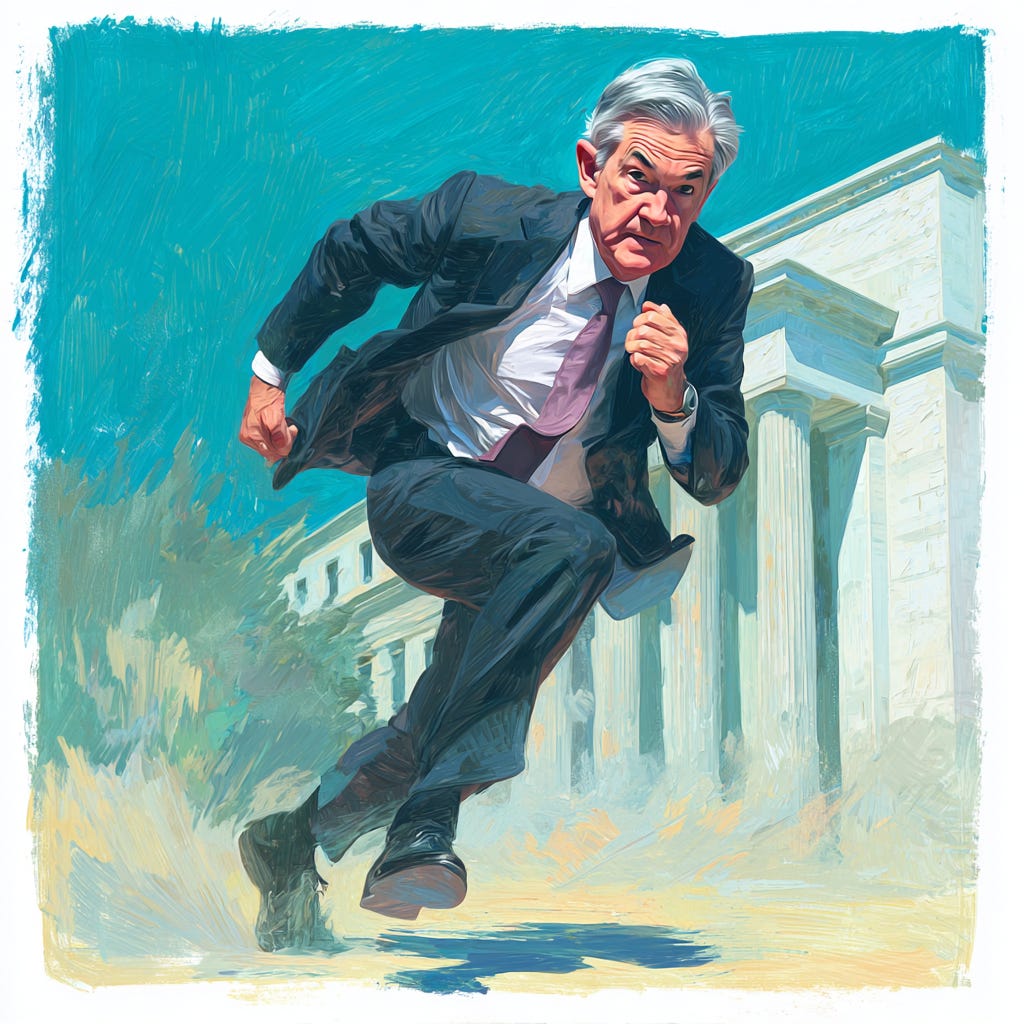
In the intricate dance of monetary policy, Federal Reserve Chair Jerome Powell has positioned himself as a cautious maestro, orchestrating a delicate balance between inflation and employment.
Yet, as President Donald Trump’s economic agenda—marked by sweeping tariffs and a push for growth—gains momentum, Powell’s refusal to lower interest rates is beginning to look less like prudent economic wizardry and more like a deliberate effort to obstruct Trump’s vision.
The evidence is mounting: from contradictory rate decisions to a weakening labor market and dissent within the Fed’s own ranks, Powell’s implacable stance raises questions about whether his motives are purely economic—or tinged with political bias.
Inflation is no trifling matter. It erodes purchasing power, destabilizes markets, and burdens everyday Americans. Powell has repeatedly justified his decision to hold interest rates steady at 4.25%-4.5% by warning of “tariff-based inflation” looming just around the corner. Yet this caution stands in stark contrast to his actions in the lead-up to the 2024 election.
A message from our sponsor (piece continues below)
Together with Money (Pet Insurance)
Protect against rising vet costs with pet insurance

The cost of veterinary services has been rising recently, with some common surgical procedures costing up to $7,000.
Pet insurance can help cover accidents, illnesses, and even routine care, with some plans reimbursing up to 90% of costs.
Our Best Pet Insurance list can help you find affordable coverage starting at just $10 a month so you can focus on what matters most – your furry friend's well-being.
(Continued)
In October 2024, when the Consumer Price Index (CPI) showed inflation running at 2.6% and the labor market only added 12,000 jobs Powell and the Fed cut rates three times, citing cooling inflation.
Fast forward to May and June 2025, with inflation slightly higher at 2.7% at but with a labor market that is clearly contracting, Powell has slammed the brakes on the idea of rate cuts, claiming the need to monitor tariff-driven price increases. This inconsistency is glaring: inflation was “manageable” enough for rate cuts when it was politically expedient before an election, why is it now an “insurmountable” barrier when only 0.1%?
The labor market, a cornerstone of the Fed’s dual mandate, is showing cracks that Powell’s high-rate policy may be exacerbating. The Bureau of Labor Statistics’ July 2025 jobs report revealed a troubling slowdown, with only 73,000 jobs added—well below expectations of 100,000—with the unemployment rate at 4.3%. This follows a pattern of weakening employment data, with hiring stalling in key sectors outside healthcare and government. Powell’s insistence on holding rates to combat hypothetical tariff-driven inflation is beginning to sound like the boy who cried wolf. The Fed’s role is to balance employment and price stability, yet its current stance risks tipping the scale toward job losses. By prioritizing a speculative inflation surge over tangible labor market deterioration, Powell is failing to uphold the Fed’s mandate, with American workers bearing the cost.
These questions about Powell’s motives are not conspiracy theories but grounded in a broader context of bureaucratic resistance. Recent revelations by Tulsi Gabbard about the origins of the Russiagate conspiracy—detailing how senior officials, including former CIA Director John Brennan, manipulated state mechanisms to undermine Trump’s first term—cast a long shadow. Brennan’s role in promoting the discredited Steele dossier exemplifies how high-ranking officials have used their positions to thwart Trump’s agenda. Given this history, it is not unreasonable to ask whether Powell’s actions are driven solely by economic data or influenced by personal or political opposition to Trump. We shouldn’t have to ask or need to ask, but sadly that is where we are.
Questioning the Fed’s independence in this context is not about destabilizing trust in institutions but acknowledging a decade-long pattern of unelected state actors leveraging their authority against elected leadership with which they disagree.
The Fed itself is not a monolith, and cracks in its unity are becoming evident. For the first time since 1993, two Fed governors—Christopher Waller and Michelle Bowman—dissented at the July 2025 meeting, advocating for a quarter-point rate cut. Their argument: the labor market’s fragility demands action, and tariff-driven inflation is likely temporary. This rare double dissent signals significant internal disagreement with Powell’s approach. Further, the abrupt resignation of Biden-appointed Governor Adriana Kugler in August 2025, while not explicitly linked to policy disputes, hints at internal discord. Kugler’s departure, coupled with the dissent, suggests the Fed is not moving in lockstep behind Powell. Are these fissures a sign that some governors see through the veneer of Powell’s economic rationale?
Even Wall Street is growing restless. CNBC’s Jim Cramer, a longtime market observer, has publicly urged Powell to cut rates, arguing that July’s dismal jobs growth demands action. “The Fed is behind the curve,” Cramer warned, echoing a broader sentiment that Powell’s inaction is misaligned with economic realities. When seasoned pundits join Fed governors in questioning the central bank’s course, it underscores a growing consensus that Powell’s stance is increasingly indefensible.
No one disputes the complexity of the Fed’s task, navigating Trump’s tariffs and their uncertain economic fallout. But Powell’s persistence in holding rates steady to combat "tariff based inflation” that is always coming “next month” despite mounting evidence of labor market weakness and internal dissent, invites scrutiny. His pre-election rate cuts, juxtaposed against his current intransigence, suggest a selective application of caution that aligns suspiciously with political cycles.
The historical precedent of senior officials obstructing Trump’s policies, combined with the Fed’s internal fractures and Wall Street’s frustration, provides ample reason to ask: Is Powell’s refusal to cut rates driven by economic fact or personal bias? Asking this question is not destabilizing.
After all, it’s not like this hasn’t happened before.

History has shown time and again that despite all the angst over Fed "independence", it has always been an incredibly political organization, and more concisely, a partisan one as determined by the 90+% of Fed economists who are registered democrats. Consider that some of the most dovish governors, Cook and Jefferson, who were all about low rates during the inflation run in 22-23, are suddenly concerned.
It is worth remembering that we had no persistent inflation when there was no Fed ( pre-1913). Since then the purchasing power of the US dollar has declined well over 90%. Gold is hated by the free spenders because it is a constant reminder of their lack of self-control over spending and belief that “stuff is free.”