


Support The Capitalist, become a paid subscriber today:
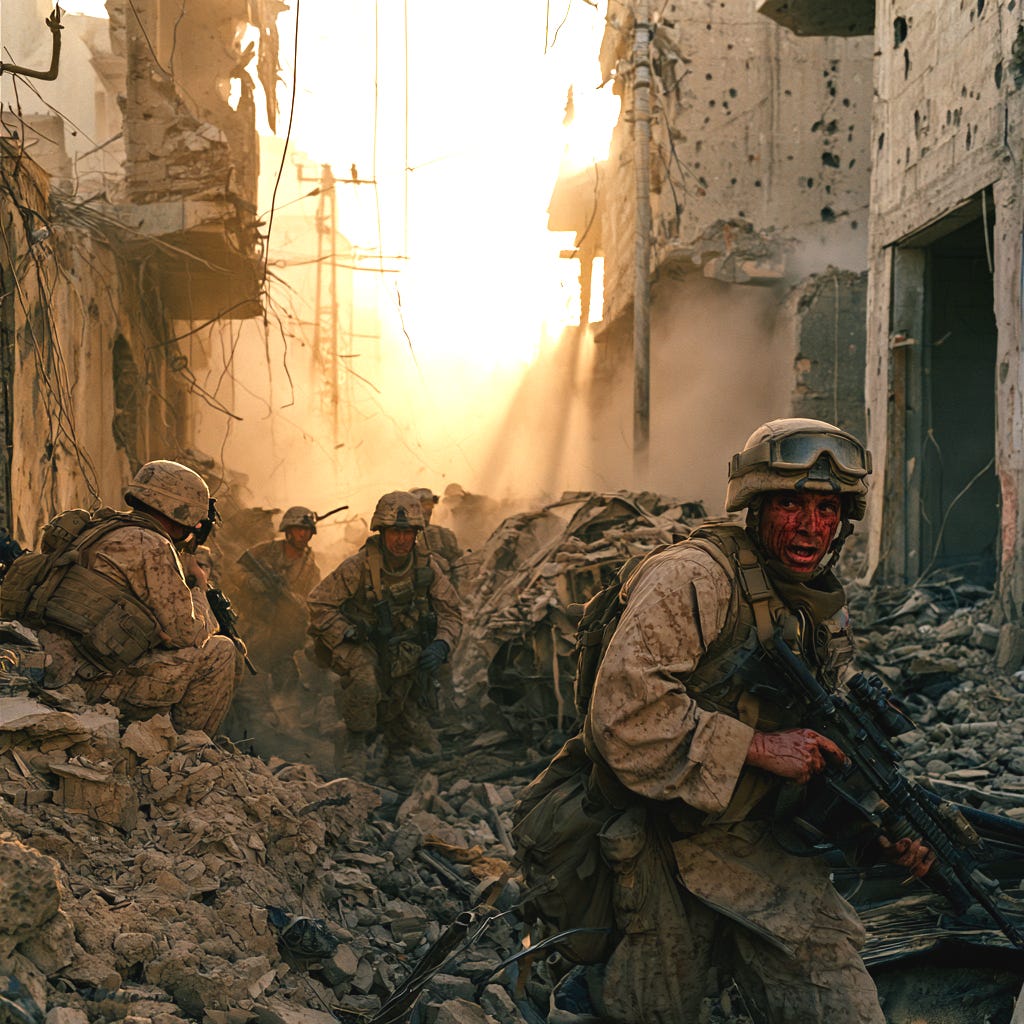
The Global War on Terror Memorial Foundation revealed the design plans for the Global War on Terror (GWOT) memorial that is slated to be built on the National Mall in Washington, DC. Designed by Japanese architect Kengo Kuma, the plan garnered a swift—and brutal—reaction online. Veterans of the (GWOT) ranging from top lawmakers to regular troops made their voices heard, expressing their dissatisfaction and disappointment with the current plan. Many demanded that the Foundation go back to the drawing board and come up with something better. Even the founder of the Global War on Terror Memorial Foundation, Andrew J. Brennan, spoke out in an opinion piece published on Military Times calling for a new design and new leadership for the Foundation.
I share their disappointment.
I served for 9 years as an infantryman in the Army National Guard, from 2003-2012. During that time, I was called up for two deployments in support of GWOT: first, in Guantanamo Bay, Cuba and then in Iraq. When I heard that there were plans in the works to place a memorial to GWOT on the National Mall, I was cautiously optimistic that it could be made in such a way that it would truly honor the service and sacrifices of those who answered the call to duty.
This design fails to do so.
Buffett's ‘Rule’ Could Make This Company Soar

Warren Buffett famously said that “If you don’t find a way to make money while you sleep, you will work until you die.”
But what if your phone could do it for you? 📲
That’s exactly what Mode Mobile has created - technology that turns idle phone time into passive income. With 490M+ users in their ecosystem and $1B in earnings and savings, their EarnPhone is being called the Uber of smartphones.
With 32,481% revenue growth, they were named the fastest-growing software company in 2023 by Deloitte, and with 7 billion smartphones worldwide their market could be significantly larger than Uber’s.
They’ve just secured their Nasdaq stock ticker $MODE, and you have until August 14 to invest in their pre-IPO offering at $0.52/share.
⚠️ Last chance to invest. Price changes on August 14.
Disclaimers
Please read the offering circular and related risks at invest.modemobile.com. This is a paid advertisement for Mode Mobile’s Regulation A+ Offering.
Mode Mobile recently received their ticker reservation with Nasdaq ($MODE), indicating an intent to IPO in the next 24 months. An intent to IPO is no guarantee that an actual IPO will occur.
The Deloitte rankings are based on submitted applications and public company database research, with winners selected based on their fiscal-year revenue growth percentage over a three-year period.
In the first place, it is unintelligible. The function of a memorial (from the Latin memoria) is to bring to mind something in order to encourage reflection. Hence, memorials should be clear in their meaning to allow the thing memorialized to be easily and readily brought to mind. This means they should not require extensive explanation to be understood: explanation interferes with the immediacy of the experience. This design fails at that basic task.
But secondly, and more fundamentally, it fails because it seems to forget what it is. This is not just a memorial but a war memorial.
The nature of war—involving, as it does, conflict, destruction, injury, and death—is such that it is inevitably tragic. Though the human condition is such that it is often necessary to engage in warfare, these aspects of war mean that it should be avoided whenever possible.
And yet, terrible as it is, war also enables a kind of human greatness. Many of the greatest human actions that punctuate human history would not have been possible in the absence of war. In his Nicomachean Ethics, Aristotle highlights the virtue of courage as that which is most characteristically displayed on the battlefield.
Though courage as turns out to be the lowest in the taxonomy of virtue for Aristotle—and even if, as Cicero reminds us, we can speak (analogously) of courage in other contexts—courage nevertheless serves to begin the movement toward higher virtues. If this is true, then it would seem to imply that there is something intrinsic to human nature that looks to war as a kind of elevation of itself.
Support The Capitalist by getting the SubStack App
Consider that many of the greatest works of literature and art—from the Iliad to the Bayeux Tapestry to the Song of Roland to the Charge of the Light Brigade to Saving Private Ryan—take war as their subject, in order to highlight the great acts of courage, commitment, patriotism, and sacrifice made possible only in the crucible of war.
Of course, war is violent and therefore it does leave wounds—physical, mental, and emotional—on those individuals who participate in them. And, for those who never return, it leaves scars on families, communities—vacancies that can never be filled. These wounds do require healing, and there is a need spaces that encourage reflection and healing are important. But as important as reflection and healing are, this is not the primary task of a war memorial.
This is for two reasons.
First, since the trauma of loss is an intrinsic part of the human condition, it is not unique to the experience of war. If memorials are simply about healing from traumatic experiences, why single out wars to memorialize and leave aside the countless other human experiences in which trauma of loss is present. The reason for building war memorials is to commemorate what is unique about war—of which, the wounding and loss is only a part. The reason for building war memorials, in other words, is first to encourage reflection on the virtues that war enables and the sacrifices it entails, and only secondarily for therapeutic purposes (if at all).
Second, war memorials serve an inherently public function: they act as permanent reminders of the war in public space. This is particularly true of those on the National Mall. Their public function is to encourage remembrance by future generations of the sacrifices made by earlier generations. In this way, they foster filial piety and gratitude. When a memorial is conflated with a therapeutic exercise, on the other hand, the memorial trends to lose meaning with the passage of time as those of the generation who endured that trauma pass on.
The Capitalist is a reader-supported publication, we exist for you, because of you!
Fortunately, there are models that we can look toward for inspiration. The recently opened World War I memorial, located just off the National Mall at Pershing Park, is an excellent example of a memorial that encourages remembrances of courage and sacrifice. Its stunning bas relief, designed by sculptor Sabin Howard and entitled A Soldier’s Journey, echoes the Campbellian “hero’s journey” motif. Yet, it is not simply jingoistic. It does not shy away from depicting the hardship and tragedy of war, but neither does it wallow in it. It perfectly captures both the heroism and the horror of war—and the burdens borne by those who participate in the fighting, as well as those who are left behind.
One suspects that this was made possible by the fact there are no living veterans of that war, and, in that sense, there was no temptation toward the therapeutic. In this sense, the task of a war memorial was far clearer in that case: inspiring remembrance for future generations. We can, and should, learn from this model. By asking “what will this monument mean once all those who served or lost someone in this war are gone?” we can more clearly recognize the proper task of a war memorial: public anamnesis for the preservation of cultural memory and the recognition of the greatness that is paradoxically enabled only by the tragedy of war.
Shaun Rieley is Director of Educational Programs and Teaching Fellow at Hillsdale College’s Washington, DC Campus.
Let us know your thoughts in the new Capitalist chat portal.
The proposed Global War on Terror memorial is not merely an aesthetic failure. It is a cultural confession.
A war memorial’s first duty is to name what war demands and what it reveals: courage under fire, acceptance of death, the willingness to impose and endure hardship for something larger than personal safety. That is why earlier generations built monuments that still speak without requiring a brochure. They understood that the public memory of war must preserve the hard virtues or the next generation will have no living standard when the next test arrives.
The current design does the opposite. It leans into abstraction, therapeutic atmosphere, and the soft language of healing. It treats the central fact of war—men ordered into lethal risk—as secondary to the management of trauma. In doing so it participates in the same inversion we see across the institutions: comfort and emotional safety elevated above adversity, mission, and the acceptance of cost.
This is not compassion. It is preparatory disarmament. A society that memorializes its wars primarily as occasions for collective therapy is a society that has already decided the older martial virtues are too dangerous to hold up in public. When comfort reigns over adversity, the war is lost in the culture long before it is fought in the field. The memorial simply makes the preference visible in stone and landscape.
Compare this to the standard of maximum effort that once governed the air crews over Germany or the infantry in any serious campaign. Those men were not invited to process their feelings as the primary public good. They were required to push past ordinary limits because the alternative was defeat. A nation that still believed its own continuity justified that cost could build memorials that told the truth about it. A nation that no longer does will produce memorials that obscure it.
China and other serious powers do not share this confusion. They still treat civilizational continuity and the hard virtues required to defend it as legitimate. They do not lead with therapeutic language when the requirement is endurance. They wait while the side that preaches peace and safety, and designs its monuments accordingly, continues the internal work of softening.
The veterans objecting to this design are right. A war memorial that forgets it is a war memorial has already surrendered the ground. Future generations will walk past an elegant space that teaches them nothing about what was actually required. That is not remembrance. It is managed forgetting.
Semper Fi!!!
🙏